Speech Therapy for Children with Cerebral Palsy: What Every Parent Must Know
In this article
If you’ve recently been told your child has cerebral palsy, you’ve probably received a flood of medical terms, therapy recommendations, and advice — much of it confusing. One thing you may have heard is: “Your child needs speech therapy.”
"At NeuromotionIndia, speech therapy is led by experienced specialists including Dr. Komal Sharma, ensuring personalised and evidence-based care for every child. — A mother, sitting across from our therapist at NeuromotionIndia |
That confusion is completely normal. And that’s exactly why we’ve written this guide — to give you real, practical answers in plain language, so you can make confident decisions for your child.
What Is Cerebral Palsy and Why Does It Affect Speech?
Cerebral palsy (CP) is a neurological condition caused by abnormal brain development or brain injury, usually occurring before, during, or shortly after birth. It primarily affects a person’s ability to control movement and posture.
Here’s what many parents don’t realize: speech is also movement. Talking involves a highly coordinated sequence of movements — lips, tongue, jaw, soft palate, vocal cords — all working together in a precise rhythm. In children with CP, the same neurological differences that affect the arms or legs can also affect these muscles.
Some children struggle to form clear words (dysarthria)
Some find swallowing food or liquids difficult (dysphagia)
Some understand everything around them — but cannot express themselves verbally
Some have a combination of all of the above
Speech therapy at NeuromotionIndia addresses every one of these challenges — not just “talking,” but helping your child connect meaningfully with the world around them.
Why Early Speech Therapy Matters More Than You Think
The human brain is remarkably adaptable in the early years — a concept called neuroplasticity. When therapy begins early, the brain can form new pathways to compensate for areas affected by CP. Every session literally builds new neural connections.
Key Insight from NeuromotionIndia Research consistently shows that children who begin speech therapy before age 3 make significantly greater long-term gains in communication than those who begin later. If your child has been diagnosed — don’t wait. |
Missing this window doesn’t mean all hope is lost. Progress is possible at every age. But early intervention gives your child the greatest possible advantage.
What Happens During a Speech Therapy Session?
Many parents imagine a clinical, sterile environment where a therapist sits across from their child repeating words. The reality at NeuromotionIndia is very different.
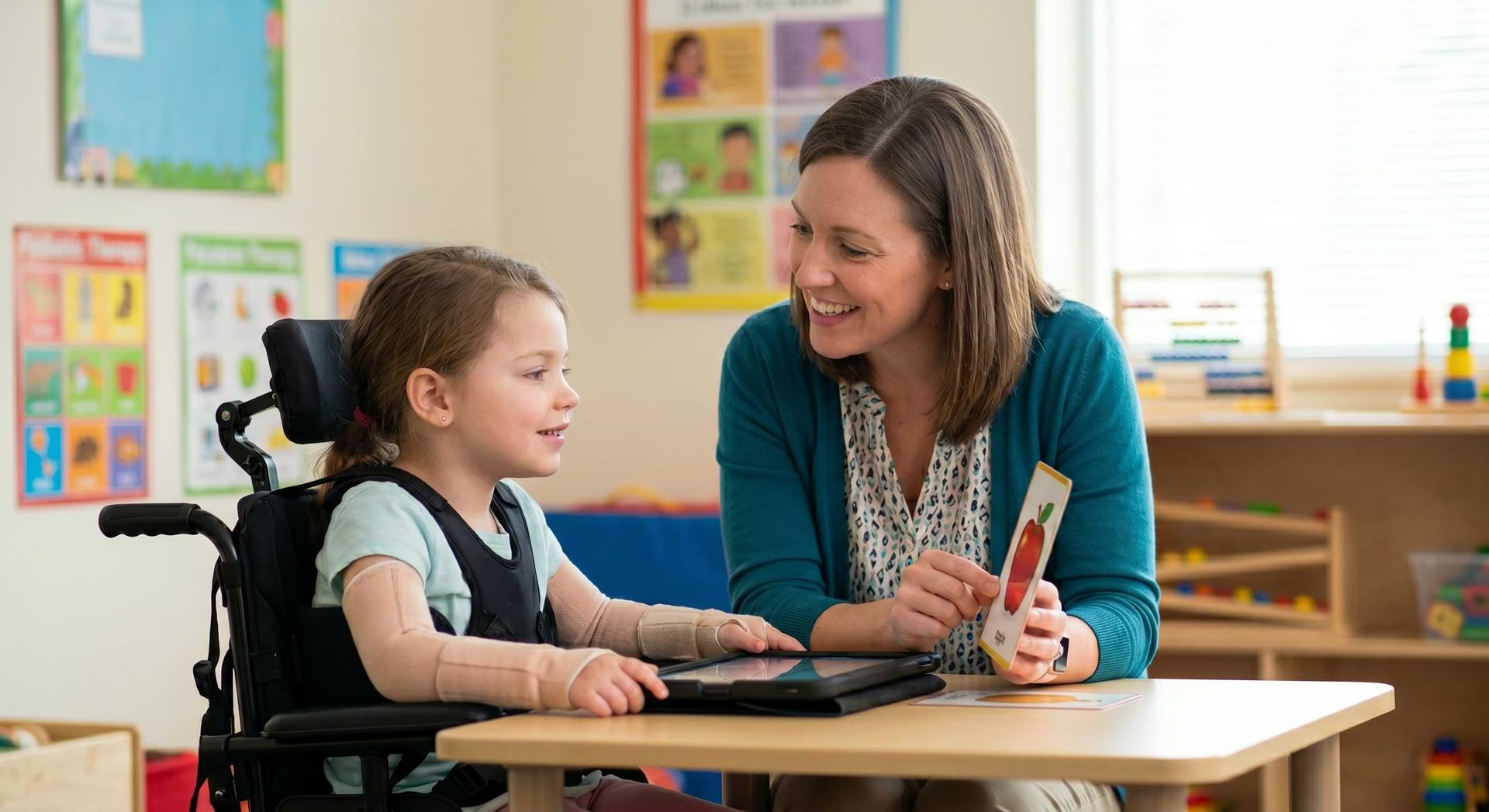
Sessions are warm, playful, and tailored to each child. A therapist builds trust and comfort first — because a relaxed child learns faster. Here’s what a typical 30–45 minute session includes:
1 | Oral Motor Warm-Up Exercises Before speech comes muscle control. Therapists work on strengthening mouth muscles through targeted activities — tongue movements, lip shapes like “oo” and “ee,” jaw resistance exercises, blowing bubbles, and cheek puffing. |
2 | Articulation and Sound Practice Certain sounds are harder for children with CP — especially those requiring precise coordination like “s,” “r,” or “l.” Therapists use mirrors, guided mouth movements, and repetition to break these sounds into manageable steps. |
3 | AAC — Alternative and Augmentative Communication If verbal speech is limited, children can still communicate powerfully using picture cards (PECS), communication boards, speech-generating tablet apps, or eye-gaze systems. |
4 | Feeding and Swallowing Support (Dysphagia Therapy) Many children with CP struggle with swallowing safely. Our therapists address safe eating techniques, correct head positioning, food texture modifications, and oral sensitivity reduction. |
5 | Language Development and Social Communication Beyond speech, therapy builds a child’s ability to understand instructions, answer questions, express needs, and engage socially. When a child can finally say “I want this” or “I don’t like that” — that is life-changing independence. |
What Speech Therapy Can — and Cannot — Do
WHAT IT CAN DO ✓ Improve speech clarity ✓ Build communication skills ✓ Make eating safer ✓ Reduce daily frustration ✓ Support school participation ✓ Enable social connection | WHAT IT CANNOT DO ✗ Cure cerebral palsy ✗ Work without consistency ✗ Replace a team approach ✗ Deliver overnight results |
Speech therapy works best as part of a multidisciplinary team — alongside physiotherapy, occupational therapy, and ongoing medical care. At NeuromotionIndia, we coordinate with your child’s full care team to ensure every intervention supports the others.
The Role Parents Play — It’s Bigger Than You Think
Therapists guide. But parents make the biggest daily impact.
Home practice between clinic sessions is not optional — it is essential. The words your child hears, the activities you do together, and the encouragement you provide between sessions determine how quickly progress happens.
Read aloud to your child daily — even if they don’t respond yet
Use the communication board at mealtimes
Celebrate every small success — a new sound, a new gesture
Maintain consistency — even small daily practice beats long infrequent sessions
What Parents Actually See After 6 Months
When we ask families what changed after consistent therapy, we don’t hear technical reports. We hear things like:
| “He says ‘mama’ now. Before, he only cried when he needed something.” |
| “She raised her hand in class for the first time. Her teacher called me that evening.” |
| “Now he can tell us what he wants to eat. It sounds small — but it changed everything at home.” |
| “My daughter can say ‘no.’ For years, she had no way to refuse. That one word gave her back her dignity.” |
That is the real measure of success — not clinical scores, but a child finally being understood.
Why Many Children Still Miss Out on Speech Therapy
Despite the clear evidence, a large percentage of children with CP in India never receive adequate speech therapy. The barriers are real:
Lack of awareness — many families don’t know it’s necessary
Geographic distance from qualified clinics
Financial limitations
Social stigma around disability and therapy
Important Speech therapy is not a luxury. It is not optional. It is just as medically necessary as physiotherapy or medication for a child with cerebral palsy. NeuromotionIndia now offers both in-clinic sessions and online therapy programs — so distance is no longer a barrier. |
A Story That Changed How We Think About Success
A 3-year-old boy came to us unable to produce a single word. His parents had been told by one specialist that he probably never would speak. We started small — with a simple picture communication board. Then a tablet-based speech device. His mother practiced with him every single day, without fail. Slowly, sounds began to emerge. Then words. Then combinations. By age seven, he stood up in his classroom and gave a presentation — using his communication device, while a classmate voiced his words aloud. He didn’t speak the way others did. But he communicated. He expressed. He participated. He belonged. That is what speech therapy does. It doesn’t just train the mouth — it gives a child a voice, and with that, a place in the world. |
Frequently Asked Questions
Can speech therapy help a non-verbal child with cerebral palsy?
Absolutely yes. Many children with CP who cannot produce verbal speech benefit enormously from speech therapy. Therapists use AAC tools — picture cards, communication boards, tablet apps, and eye-gaze systems — that allow children to express themselves meaningfully without spoken words. Communication is not the same as speech.
At what age should speech therapy start for a child with cerebral palsy?
As early as possible — ideally as soon as a diagnosis is confirmed, which can be as young as 6–12 months. The brain is most plastic (adaptable) in the early years. However, therapy is beneficial at any age, so do not delay because your child is “too old.”
How many sessions per week does a child with CP need?
Most children benefit from 2–3 sessions per week, combined with daily home practice. Your NeuromotionIndia therapist will assess your child individually and recommend a frequency based on the severity of challenges, age, and goals. Consistency matters more than volume.
How soon will we see results from speech therapy?
Many families notice early signs of progress within 2–3 months — such as improved eye contact, new sounds, or reduced frustration during communication attempts. More significant milestones typically become clear within 6 months of consistent therapy and home practice.
Does speech therapy hurt or upset children?
Not at all. Skilled therapists at NeuromotionIndia design sessions to feel like structured play. Most children look forward to their sessions. Therapists work at the child’s pace and prioritize building a comfortable, trusting relationship before any therapeutic work begins.
Is online speech therapy effective for children with cerebral palsy?
Yes. Teletherapy has proven effective, particularly for children who have already established a relationship with their therapist. NeuromotionIndia offers structured online sessions and guided home programs that allow families across India to access quality speech therapy regardless of location.
Can parents do speech therapy exercises at home?
Yes — and you should. Home practice is a core part of every treatment plan at NeuromotionIndia. Our therapists provide parents with specific, easy-to-follow exercises and activities that can be done in 10–15 minutes daily. The combination of clinic sessions and home practice produces the best outcomes.
Book a Free Consultation: www.neuromotionindia.com